All of us know stories of the Holocaust. Recently, I read something on social media that claimed that The Diary of a Young Girl is among the ten most widely read books in the world. Don't get me wrong; stories of the Holocaust are crucial. They teach us lessons that are horrifyingly relevant today. Yet, when we read stories about Germany, Hitler and the Jews to the exclusion of stories of horrors that have occurred - and continue to occur - in other parts of the world, we feed into the age-old problem of Eurocentricism. We need other stories so that we don't think of the Holocaust as one terrible period in history, which is over and done with. Before We Were Free is the story of a child living under a dictator in the Dominican Republic. Twelve-year-old Anita does not believe that she is not free. What does that even mean? She lives with her extended family and … [Read more...]
Monsters and Stereotypes
I'm so happy with all the lovely responses I've been getting to my essay, "The Problem With Monster Stereotypes In Literature"! Thank you for the love. It's been ages since I wrote something remotely academic, so I was nervous about this piece. The writing of the essay started with all the monster posts I've been writing here on my blog, particularly after workshops I conduct with children and adults. How do we imagine monsters? What forms the bedrock of our imagination of monsters? With all my activities around the creation of monsters, it was time to take the idea further, examining why children so often create monsters that are fat, ugly, dark-skinned and male. The word count did not allow me to include everything I would have liked to, particularly as there are so many books that do try to create new kinds of monsters. One book that comes to mind featured in an earlier … [Read more...]
Working with Poetry
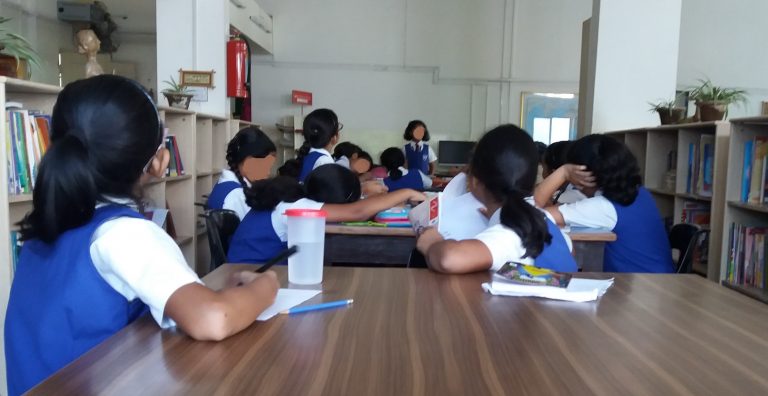
Many children write poetry. Rhyme is fun, having your poem published in the school magazine is even more fun. Teachers and parents encourage children to write poetry, which is good. Of course there's a 'but'. People have been writing poetry forever. Forget the ancient languages, in English alone, even those who don't opt to study Old English begin by studying Chaucer et al, who wrote almost 700 years ago. When children write about rainy days and their favourite pets, what are they doing to make their work stand out? Why will their work be special? That's what we work with when I conduct poetry writing workshops. Yesterday's workshop As we played with poetry, people kept popping in to ask what was happening. A Sunday afternoon at a library meant we had lots and lots of visitors. Exasperated with the interruptions, the children finally asked me, "Why do so many people want to … [Read more...]
Working with Stories
Stories are magical; we all know that. What is even more magical is when you can feel creative energy pulsing all around you and then see those ideas transforming into stories. Creative Writing with Children Yesterday, at The Story Station, I met a group of enthusiastic young children, bursting with ideas. One boy had made a list of ideas that he wanted to develop into stories. And as a writing exercise, he came up with a portal to Legoland! A six-year-old told me she wants to write scary stories. Her first story was about Nina and the monster under her bed. The second was about falling through a wall into a place where it was Halloween! Terrified of a skeleton there, she ran back through the wall to safety. Yes, she is six (okay, six and a half, she would insist) years old, and yes, she wrote it right there in front of me during my workshop. Creative writing workshops … [Read more...]
The 13-Storey Treehouse
Have you ever read a book that was not at all "your" kind of book, but you ended up enjoying it anyway? The 13-Storey Treehouse was exactly that, for me. It was a gentle reminder that I never know what my "kind" of book is until I read it. Why was it not my kind of book? Two reasons immediately come to mind. One, I don't like books with so many pictures unless they're picture books. Two, I often don't like the kind of humour we find in The 13-Storey Treehouse. Why did I pick it up? One huge reason: children love it. When I conducted workshops for the British Council's Big Friendly Read Reading Challenge, everyone's favourite book was The 13-Storey Treehouse. This was several years ago, but the number of children who said it was the best book in the collection made me remember the title and look out for it. Even when I picked it up, I … [Read more...]
The Explorer
With some writers, I feel I just cannot go wrong. Katherine Rundell is one of them. Sure, I like some books more than others, but at the end of each one, I find myself smiling, deeply contented. I didn't write about the first two books I read by Rundell (The Girl Savage and Rooftoppers), but I did review The Wolf Wilder, which was one of the top ten middle-grade books I read in 2018. The Explorer began slowly, just like The Wolf Wilder. I took a while to get into the story and feel for the characters - I even read another book in between. Yet, when I came back to The Explorer, I stayed, sucked into the secrets of the jungle. A six-seater plane crashes into the Amazon rainforest. The pilot dies, leaving four children who barely know one another. There's Lila, who is fiercely protective of her five-year-old brother Max. Then there's Con, who seems … [Read more...]
The Case of the Candy Bandit
There were so many things I liked about The Case of the Candy Bandit! For one, I enjoyed the fact that the Superlative Supersleuths were a pair of girls - aided (temporarily) by another girl. I liked the seriousness with which Rachita went about the business of being a detective, and I loved all the sprinklings of humour, particularly the outrageous hypotheses the girls came up with. Could the candy bandit be the counsellor conducting some sort of secret research experiment on the children? At Rachita and Aarti's school, to encourage the children to finish their lunch, the counsellor suggests that they be given a treat--which is to be denied if the children do not eat their lunch. One day, though, many of the treats disappear. And this happens not once, but a number of times. Aided (maybe ... somewhat ...) by the idea of the centre of gravity, Rachita must … [Read more...]
His Royal Whiskers
I giggled and gasped at how imaginative this crazy story is. Full of puns and clever humour, I chuckled at Empurrer Alexander, six-year-old prince who is turned into a cat by a young alchemist, Teresa. It could have been a CATastrophe; instead it was purrfect. I know lots of people would not recommend this book to children; I wonder whether I would have enjoyed it as a child, for there are parts that are gloomy, other parts that are gory, and still others that are gruesome. Yet, I enjoyed the book. Sam Gayton's imagination is incredible! The first book I read by him was Lilliput. I loved it, but somehow ended up writing just a one-line review. I later read The Snow Merchant, which I enjoyed too, though not as much. His Royal Whiskers was a roller-coaster ride for the imagination, with every twist and turn as plausible as the previous one, but as gasp-worthy. Teresa and Pieter … [Read more...]
Arangetram – Sakshi and Shivona
As I write this post, I look back at the number of times I've written about an Arangetram. Some are just posts sharing details of upcoming arangetrams, but others ... The emotions after - in August 2013A reflection on the idea of the Arangetram itselfWhat I felt after an Arangetram in 2014Our Arangetram anniversary I write so frequently about the Arangetram because for us, at the Academy of Indian Dances, each Arangetram is significant for everyone. I don't know if this is true for other dance schools too, but for us, it is a moment when all of us are charged with emotion. We are excited and nervous. Even though we are not going to be on stage at all, we are all part of the experience. We are part of this moment in each dancer's life. After today's Arangetram, 49 girls from the Academy will have reached this landmark. These dancers are scattered all over the globe. Some … [Read more...]
Operation Eiffel Tower
Jack hates it when his parents row. He wants to hide away from all the shouting, crying and smashing of plates. It is no different for his little sister Ruby. When their parents fight downstairs, Ruby sneaks into Jack's room, afraid and anxious. Jack knows that somehow, he has to get his parents together again. They were in love once; what changed? Is it ... could it be ... that there are too many children? Are Lauren, Jack, Ruby and little Billy the real problem? Lauren and Jack, being the oldest, come up with a plan to get their parents together again, a plan called 'Operation Eiffel Tower'. Paris is the most romantic place in the world and Lauren's teen magazine tells her that dinner in Paris is guaranteed to bring the spark back into any relationship. The problem is that the children need to put together two hundred pounds to make it happen. Operation Eiffel Tower is the … [Read more...]
- « Previous Page
- 1
- …
- 63
- 64
- 65
- 66
- 67
- …
- 146
- Next Page »