Blue Shoes and Happiness
A colleague of mine saw me reading the book and commented on how it looked like a children's book.Many people don't know yet that I spend more time reading children's books than anything else - and am not ashamed of it.This one was delightful, as Alexander McCall Smith usually is. It's the kind of book you can read slowly, knowing that it will not run away. You know that you won't forget crucial details that contribute to the plot. You know that the focus of the story is not the plot, but life itself. You know that ideas and thoughts will un-self-consciously find their way into description and dialogue. The name itself brings that sweet smile and says, "Hey, that's a book I want to read!"I took my own time to read it, chuckling at traditionally-built women, women who dream about shoes and men who dream about cars and garages. I remembered, once again, the fact that cliches are … [Read more...]
A Doll’s House
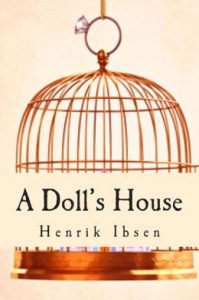
I cannot believe that Ibsen changed the end of the end of A Doll's House for its production in Germany! What happened to [t]hat slammed door [that] reverberated across the roof of the world? Ibsen agreed to make Nora go back to her children? Shocking!Almost as bad as Shaw making Eliza go to Mr. Higgins at the end of My Fair Lady, thereby changing the end of Pygmalion. But then, Shaw did not believe that he was giving the movie-watching public a happy ending. What kind of happy conclusion had a young girl going back to a cynical, selfish, middle-aged man?I remember how much of an impact A Doll's House made on me the first time I read it. For me, it was far more potent than An Enemy of the People, the text we had to study. It made me think about women, family, mother, role-playing.... I later read a beautiful tongue-in-cheek piece about how linking the woman … [Read more...]
Miss Julie
Outstanding.To create passion like this and alternate between expressed passion and subdued passion is incredible.Miss Julie - headstrong and confused - wavering between strength and weakness - is a work of art. You hate her and admire her. Above all, you pity her. Or maybe not above all. There's no 'above all'. It's impossible to have a single emotion after a play as powerful as this one. A range of emotions rises and falls, leaving you almost breathless.Then, there's Jean - another work of art. Power-hungry, ambitious, practical. When I think about it, a character like that ought to be unbelievable. Yet, he's not. He's wholly believable, wholly despicable - and wholly worthy of hateful admiration.Christine - I wish I knew her. I wish she could just look at me with her grey eyes and hold my hand. Because then, the world could, perhaps, be good. … [Read more...]
Hullabaloo in the Guava Orchard
Why does 'easy to read' somehow strike me as a slightly negative comment in the context of this book?Yet, I would not say I disliked the book. The gentle humour made me chuckle time and time again. The paradox of unbelievable believable characters was wonderful. Each character was more than just a character. The characters came alive despite being so exaggerated and unreal. Hullabaloo in the Guava Orchard did not end one page too early or one page too late.I think what made the book seem deserving of moderate praise rather than great praise was simply the fact that I find it forgettable. The fact that even though I just finished the book, I choose to write 'Each character was more than just a character' not 'Each character is more than just a character'. It's not one of those haunting stories that stays with you and makes you feel as if the character is a dear friend you want to … [Read more...]
Sylvie and the Songman
What a crazy book.And that's a compliment.There were parts of the book that I read only because I wanted to finish the book. I pushed myself to read, page after page, completing each chapter before putting the book down. So I simply can't give it those overused compliments - 'page-turner' and 'unputdownable'.When imagination is truly beautiful, there's such a strong semblance to life that there's no need to understand each detail. The world is like that. There are so many questions that we ignore. We don't feel the need to answer or even understand the questions. Why do fiction writers so often feel the need to explain everything?Sylvie and the Songman made me think. I did not need to understand everything. I needed to accept and marvel. The ideas were magnificent. The concept of music was thrilling, frightening, enlivening.And like all good books, it made me ask why we create. … [Read more...]
A Note of Music
Everything is made out of notes, vibrations. Many people think the universe started with a great big bang. What's that if it isn't a note, albeit a rather loud one? Somewhere there's probably a note that brings the whole universe together... Goodness knows what will happen if anyone finds it... We'll probably be blown up; either that or we'd find ourselves in another universe. - from Sylvie and the Songman by Tim Binding That, succinctly put, is the power of music. … [Read more...]
The Bluest Eye
Toni Morrison introduced me to the real horror of slavery. When I read Beloved, I simply could not get over the idea of black slaves being forced to wear the bit. I still cannot get over it.'Racism', in the way it exists in the west, simply does not exist in India. Sure, we have discrimination, perhaps discrimination of the worst possible kinds. We also have an obsession with fair skin. I like to think that the obsession is on the decline, but I'm horrified by the number of times I come across it in the most casual ways.The Bluest Eye was another of those eye-openers. A black child, looking at the fact that little blond babies with blue eyes are caressed, loved and cooed over, wishes for blue eyes herself. The idea of very black skin and very blue eyes is simply appalling. The child prayed, prayed, prayed for blue eyes. Why? Why did she need them? So that she would be loved? So that … [Read more...]
The Dictionary at School
The portion for the exams has been completed; students are fed up with revision. So, a colleague of mine decided to do something different - she read out a story from The Story-Catcher. I was thrilled!This reading went one step further than 'I loved your story' and 'nice story' and 'I like the story of Sana'. After listening to The Dictionary, the students were expected to write a poem. It had to be inspired by the story, but they could write what they liked.And so they did. I was waiting to have a look at their work, and that happened in a lovely way too!On Thursday, a Student Held Conference took place at the school library. The library was jazzed up a little to make it slightly more attractive.One large notice-board was dedicated to The Story-Catcher. Poems covered the board. One child even made a beautiful copy of the cover illustration. I looked at all the poems in … [Read more...]
Non-Cooperation
Leela Samson, in her book Rukmini Devi writes:'Mrs Besant disagreed with Gandhi on the issue of non-cooperation. Her opinion was that mass civil disobedience was fraught with dangerous possibilities. She was apprehensive of the nation's integrity being weakened as a result. She repeatedly warned that if and when India attained swaraj, it should be careful not to 'find itself in a condition of anarchy, resistant of all discipline, defiant of all authority, where everyone was a law unto himself, enforcing his will by mobs, or trampled on by superior force'. The wisdom of the statement she made then rings frighteningly true today.'Later, India forgot its resentment against Mrs Besant and embraced her as one of those who worked for its independence. I wonder, could things have worked differently? … [Read more...]